Minggu, 26 Februari 2012
"Stone Cold Ginger Beer" - The Station Refreshment Room after 1870 - Part 1
Minggu, 07 Agustus 2011
Digitising Records - Thoughts on Ancestry's New Digital Archive of Railway Staff Records
My first thought was ‘oh crap.’ As some of my long-time readers will be aware, part of my PhD focuses on the lives of the London and South Western Railway's (L&SWR) managers and I have done extensive research on the company's staff records. Indeed, I spent many long hours photographing 3000+ L&SWR clerks' staff records held by the archive. As such, you can understand my initial frustration that the digitised records did not appear two years ago, as it would have saved me monumental amounts of effort. However, on reflection this was more annoying than anything else and there are massive benefits for my work as now I can access with ease all the records I hadn’t photographed.
The records cover the staff of seven railway companies that existed before 1st January 1923, and three of the ‘Big Four’ companies that existed after it. They are as follows:-
Pre-1922 Railway Companies
Great Western
London and North Western
London and South Western
London, Brighton and South Coast
London Chatham and Dover
Manchester, Sheffield and Lincolnshire (Great Central from 1899)
Midland
Post-1922 Railway Companies
Great Western
London and North Eastern
London, Midland and Scottish
Furthermore, what has been digitised is more than just individuals’ employment histories, and also included, where available, are accident books, books of disciplinary action and pension details.
Therefore, for historians, as opposed to genealogists, this opens up a number of research opportunities from the comfort of their home. Social historians can investigate labour relations, women's employment, accident rates, poverty, railway employees’ backgrounds and ages of appointment. Business historians can also get data on internal labour markets, pay scales, discipline, company hierarchies, promotional trees and the companies’ management class. Furthermore, because the companies served different parts of the country, regional variations in all these subject areas can be drawn out.
However, this isn’t to say that everything to do with the records is rosy for the historian. As with all things on Ancestry, my feeling is that its search engine is geared to genealogists. I understand why this is so. After all, it is a website for genealogists and it is predominantly their subscriptions that pay for records to be digitised.
Nevertheless, the ‘family history’ perspective doesn’t make it easy for individuals wanting to use the records for historical research that is non-genealogical. On the positive side, I can search for employees by region, date of entry into service, birth date and by railway company. Yet, there are some annoying things that the search engine won’t allow. Apart from a few individuals, I cannot search for all employees that worked at a particular site, for example Hampton Court Station. Furthermore, I cannot search the database it by gender (which can be done on the rest of the Ancestry site) and nor can I have listed all the individuals that worked in a particular position, for example porters. Therefore, if Ancestry had the time or the money to add these features to the search engine it would be useful.
Additionally, I think there is scope for the database to be expanded. In the back of David T. Hawkins’ Railway Ancestors there is a list of the railway companies whose staff records survive in The National Archives. Thus, it seems that vast numbers of records were not included in the digitisation project. A couple of large companies that existed before 1923 did not have their records digitised, such as the North Eastern and Taff Vale Railways. Additionally, some smaller companies, such as the Somerset and Dorset and Welshpool and Llanfair Light Railways, were also left out. Records from companies that were absorbed in larger ones were also omitted, for example the London and Birmingham and Whiteness and Furness Junction Railways. Lastly, some records survive from the Southern Railway.
I presume the the staff records from these and other companies were left out because there aren’t great numbers of them. Indeed, from some railways only one volume of staff details survive (it should also be pointed out that for some companies no records remain). Nevertheless, to expand the project to all these surviving files would be of immense value to historians.
Of course, I am now getting into wish-list territory. I do appreciate that to improve the search engine and to add all surviving railway company staff records would be a massive task that ultimately may not be remunerative. The reality is that I have no cause whatsoever for complaint. I have available to me now something that I never thought I would, a searchable database of all surviving L&SWR staff records. For that I am immensely grateful. Overall, it is a significant achievement on the part of The National Archives and all involved should be proud.
I will, however, try to get the most from this new resource. Thus, to show its value I will be using it to inform my next few blog posts.
You can see Ancestry.co.uk's railway staff record search page HERE.
Sabtu, 12 Maret 2011
Infringing The Rule Book - Causes of Dismissal on the Victorian Railway
I would love to do more work on the topic of railway company discipline. However, I do not have the time. Yet from this evidence it is clear that most of 46 clerical or salaried staff members were simply dismissed for infringing the very strict rules of the Victorian railway workplace, whereas those who were dismissed because they knowingly wanted to steal from the railway was small. Hopefully, if I do get the time, I can expand my sample to include all the L&SWR clerks, but that would be a massive task.
Sabtu, 05 Maret 2011
Victorian Railway Employees Complaining About Victorian Railway Employees
While I presume complaints were made by railway employees against their direct superiors, the senior management seem to come in for a rough time in the diary. On the 5th of April 1878 Fay took a stroll to Teddington Station to see the staff there.[1] Shortly before changes had occurred in the Telegraph Department and it's head, Mr Blake, had been replaced by a newcomer Mr Goldstone. Clearly, Blake had run his department in quite a relaxed manner. On arrival Fay had a ‘jaw’ with Goddard, a fellow clerk who was of a similar seniority to him having been with the company the same amount of time.[2] Goddard stated that the clerks were giving Mr Goldstone a bad name. Apparently, he was ‘too sharp to please them and has no favourites like old Blake had.’ Yet, even though Fay had heard the complaints of Goddard, Fay’s assessment of the situation was that Goldstone was the ‘right man in the right place.’[3] Clearly, he did not agree with his colleague’s assessment.
Indeed, at the same point Fay’s career was advancing and was becoming General Manager of the North and South West Junction Railway, in 1892,[4] Goddard was still at Teddington, and was reprimanded for being ‘short in his cash’ to the tune of £36 4s 2d. As a result, he was moved from the station to the Nine Elms Goods Depot.[5] Perhaps, Goddard’s issue in 1878 was that he was no longer the favourite of his superior, an arrangement which previously had hid his own mediocre performance under Blake. Indeed, this factor may have held his career back in later years as Fay’s advanced.
Mr Jacomb had been the L&SWR’s Chief Resident Engineer since 1870, and his remit covered the maintenance of the line and buildings.[6] But, working in a different department to the Kingston Station staff, who were in the Traffic Department, he would have had his own agenda regarding just when and where repairs and alterations were required. Thus, when the Station Agent at
Yet, it wasn’t only superiors that were in the firing line, and Fay had a run in with one of his colleagues in May 1878. The W.H. Smith bookstall at Kingston was staffed by a man named Compton. Whether this meant that he was employed by the L&SWR or Smiths is unknown. Presumably to save on his own costs, on the 6th of May, Compton travelled with four persons from Waterloo to Kingston using used tickets he had obtained from the Kingston booking office.[8] Fay, and a fellow Clerk, Osborne, who has been working at the station since 1875,[9] reported this to Mr Pettit. Petit, naturally took action and forced Compton to pay the fares. Fay recorded that Compton thought ‘it a very shabby action on our part, he has circulated a yarn of his own about the town saying nothing of the crew and tickets he had with him, we shall not, I presume, be on speaking terms for some time over it.’[10] Of course, I am only getting Fay’s side of the story on this. However, it is unlikely that this would be the sort of thing that he would make up.
Also, there is a case of Fay simply not liking someone. On Monday 17th January 1881 he wrote in his diary that he had heard that Wright, who was based at Fulwell, was about to be dismissed. Presumably through nosiness, Fay wrote to the General Manager’s office to ascertain if this was true.[11] Goffe, one of the General Manager’s clerks,[12] wrote back stating that this was not the case. Fay for some reason thought this was unfortunate. The reason he disliked Wright is unknown. However, given that it is known that Fay was a stickler for good management and efficiency, I suspect it was because he perceived Wright to be inefficient.
While Fay did, on occasion, praise his colleagues, the majority of the comments on the quality of others’ work were negative. Thus, these case studies show that while the setting is very different to any modern workplace, the Victorian railway worker had the same complaints about the actions and efficiency of fellow workers as many of us do today.
[1] Bill Fay Collection [BFC], Sam Fay’s Diary, 5th April 1878.
[2] The National Archives [TNA], RAIL 411/492, Clerical staff character book No. 2, 1838 – 1919, p.254
[3] BFC, Sam Fay’s Diary, 5th April 1878.
[4] TNA, ZPER 11/22, South Western Gazette, March 1905, p.9
[5] TNA, RAIL 411/492, Clerical staff character book No. 2, 1838 – 1919, p.254
[6] TNA, ZPER 11/6, South Western Gazette, June 1887, p.90-91
[7] BFC, Sam Fay’s Diary, 28th May 1878
[8] BFC, Sam Fay’s Diary, 6th May 1878.
[9] TNA, RAIL 411/492, Clerical staff character book No. 2, 1838 – 1919, p.456
[10] BFC, Sam Fay’s Diary, 6th May 1878.
[11] BFC, Sam Fay’s Diary, 17th January 1881
[12] TNA, RAIL 411/492, Clerical staff character book No. 2, 1838 – 1919, p.234
Sabtu, 26 Februari 2011
Football Amongst Railway Workers on the GCR (1905-06, 06-07 seasons)
Cricket was seemingly the sport of choice for many employees of the Great Central Railway (GCR) in 1905, and the first edition of the company’s staff magazine, the Great Central Railway Journal, detailed the matches that the Nottingham, Sheffield and Leicester Great Central cricket clubs played. Interestingly, many of these matches were against teams from other railway companies, revealing that inter-railway rivalry spread beyond just the speed of trains, the quality of the service or the shine of railway worker’s buttons. In May 1905 the Nottingham Club lost by 120 runs to 76 against the Nottingham Locomotive Department of the Midland Railway. However, they won against the Great Northern Railway’s Nottingham clerks by 82 runs to 45. The Leicester GCR team beat some London and North Western Railway men by 66 runs to 23. Furthermore, in addition to the inter-company games, the GCR cricket clubs also played teams from surrounding villages and groups.[3]
Yet, since the late 19th century, football had become a far more popular sport and the April 1906 edition of the Journal gave reports of Football matches that were occurring amongst GCR railwaymen. The team from Ardwick Station beat their colleagues from Openshaw, 3-0. The Doncaster District Superintendent’s Office (DSO) team beat Liverpool DSO staff members by four goals to none. Lastly, Blyton Station staff stunned the Sheffield Bridgehouses Goods Accounts Clerks by inflicting on them a 13-0 defeat.[4] This was unsurprising though, as the Blyton team was beaten only once in the 1905-06 season.[5] With footballing activity at a high level, it is interesting to note that the May 1906 edition of the GCRJ stated that there were not only teams amongst the GCR staff, but there were clubs also.[6]Indeed, a later correspondent cited that teams and clubs were established at Doncaster DSO, Hexthorpe, Mexborough, Wombwell, Stairfoot and Barnsley Goods Depot.[7] As a community of footballers, their undoubted crowning achievement of the 1905-06 season was that a united GCR team won the Hampstead and District League West London Charity Cup.[8]
In the May 1906 edition of the GCJ there was a description of the Doncaster DSO’s team that gave details of the nature of a GCR football team. It seems that its formation was a reflection of the community spirit that existed amongst the men. The team was formed because of ‘a desire on the part of some of the members of the office to meet in friendly games with the staff in the other district offices of the company.’ While the article didn’t specify a date of formation, it suggested that the team, while new, was one of the more established clubs. Growing from a small start it had become ‘a team capable of meeting many of the amateur teams in the district.’ Its star players were the Captain, Mr Storer, and the Vice-Captain, Mr Fennell, two players who were ‘capable of leading the team onto victory.’[9]
Amongst all the GCR teams the Blyton Station team stood out as being a well-established (and not to mention formidable),[10] as they were already partaking in a local league.[11] Thus, in the April 1906 edition of the GCRJ a Mr A.E. Bales, of the company’s Carriage and Wagon Workshops at Gorton, had a letter published suggesting that a company league be started. On the basis of the Blyton example he posited that ‘a league could be formed composed of employees from the GCR system.’ He suggested establishing more than one league, to be arranged in divisions, as well as a cup competition for the whole of the system. He felt that the cost would low and welcomed suggestions from ‘admirers of the winter pastime.’[12] This, therefore, would move the activities of footballers in the company to a more advanced phase of organisational development.
Many of the views were positive. E. Kimmery of the Blyton team offered his support and the use of a ground for teams that did not have their own.[13] He was supported by ‘W.A’[14] and a ‘would be football team’ from an unknown location, who suggested that it was ‘about time something was being definitely decided upon.’ They hoped that a league could be formed by the start of the next season.[15] ‘J.S.S.,’ ‘A.K.D.’ and ‘H.O.’ from Liverpool supported the idea, but raised the point that because of the size of the GCR the distances some teams would have to travel to play matches would be impractical. As an alternative they suggested two or more leagues in the districts, with occasional test matches being played between teams that constituted of the best players from both. They also suggested a central organisation to coordinate the leagues which would be based at Sheffield.[16] Subsequently, Kimmery took it upon himself to marshal the organisation of the league, writing to twenty-two stations about the proposals.[17]
Unfortunately, Kimmery reported in the November issue of the GCRJ that of the twenty two stations that he had written to, only four had replied. Subsequently, the idea was ‘to rest for the present time.’ However, he was willing to fix up friendly matches for Blyton with any GCR team.[18] Blyton in the 1906-07 season continued to be on top form, beating Chapeltown 5-1 on November 18th and the Hull Kingston Street team 11-0 on December 8th.[19]
Unfortunately, my research hasn’t taken me far enough to establish whether a football league was eventually formed in the 1907-08 season or beyond. However, it is hoped that this will be discovered soon. What this case study suggests is that football by the early twentieth was an increasingly popular pastime and that communities were arranging more than just individual matches. Cricket had dominated as the sport of choice in the 1900s. However, presumably because of the increased free time that railway employees had due to legislation that limited their working hours, football, a sport that was far more accessible and shorter in duration, quickly became popular amongst them.
--------------------------------
[1] The National Archives [TNA], ZPER 11/5, The South Western Gazette, June 1885, p.8
[2] TNA, ZPER 16/2, Great Eastern Railway Magazine, March 1912, p.73-74
[3] TNA, ZPER 18/1, The Great Central Railway Journal, July 1906, p.7
[4] TNA, ZPER 18/1, The Great Central Railway Journal, April 1906, p.240
[5] TNA, ZPER 18/2, The Great Central Railway Journal, January 1907, p.185
[6] TNA, ZPER 18/1, The Great Central Railway Journal, May 1906, p.275
[7] TNA, ZPER 18/2, The Great Central Railway Journal, July 1906, p.23
[8] TNA, ZPER 18/2, The Great Central Railway Journal, March 1907, p.238
[9]TNA, ZPER 18/1, The Great Central Railway Journal, May 1906, p.268
[10] TNA, ZPER 18/1, The Great Central Railway Journal, April 1906, p.247
[11] TNA, ZPER 18/1, The Great Central Railway Journal, May 1906, p.275
[12] TNA, ZPER 18/1, The Great Central Railway Journal, May 1906, p.275
[13] TNA, ZPER 18/1, The Great Central Railway Journal, May 1906, p.275
[14] TNA, ZPER 18/1, The Great Central Railway Journal, June 1906, p.298
[15] TNA, ZPER 18/2, The Great Central Railway Journal, July 1906, p.23
[16] TNA, ZPER 18/2, The Great Central Railway Journal, August 1906, p.54
[17] TNA, ZPER 18/2, The Great Central Railway Journal, November 1906, p.134
[18] TNA, ZPER 18/2, The Great Central Railway Journal, November 1906, p.134
[19] TNA, ZPER 18/2, The Great Central Railway Journal, February 1907, p.234
Kamis, 17 Februari 2011
Colour, Safety and the State - Colour-Blindness and the Victorian Railways
Much focus in the historical railway literature has been placed on the role that the state played in imposing safety measures on the Victorian railway companies. Less light has been shed on what the railway companies themselves did to improve the safety of the industry for both the passengers and their employees.
Towards the end of the century many medical professionals became aware that some individuals’ colour blindness was potentially a danger to the lives of the travelling public if they worked in safety-critical parts of the railway industry. By the 1850s most railway companies used coloured signals to stop and start trains. Thus, an individual who was colour-blind may not have been able to distinguish the signals’ colouration and potentially caused an accident if he misread one at danger. Indeed, this was a greater problem at night as most railways used identically sized circular light signals. In 1857 The Derby Mercury reported a lecture by Professor George Wilson. In it he stated that:-
“people who are colour-blind are generally insensible to red and green colours, or rather confound these colours when presented to the eye; and therefore, if the officers who have charge of railway signals, that are red or green, should happen to have this imperfection of vision, most serious accidents might be the consequence.’[1]
This was just one example of how those in scientific and medical circles felt about railway companies having colour-blind individuals as engine drivers or guards. Indeed, many of the individuals who spoke and wrote on this matter, especially in the 1850s when it became a widely discussed topic, called for the railway companies to introduce testing. In 1859 The Sheffield & Rotherham Independent detailed a lecture given by Edward Smith to a local Literary and Philosophical Society on the topic. He stated that “it was important that persons before they were made signal men, drivers guards etc. should be subjected to an examination, to see that they were not labouring under this defect.”[2]
But, by this point some railway companies had started to introduce colour-blindness examinations. Smith cited the case of the Great Northern Railway who had instituted one for drivers, and by 1866 the Great North of Scotland had done the same. [3] Furthermore, in January 1880 J.H. Stafford, Secretary of the Lancashire and Yorkshire Railway, wrote to The Times in response to a letter that stated that many companies did not have a test for colour-blindness. He stated that his company had had a test in place for many years and that ‘no person was appointed to any position connected with the working of the trains’ without being tested.[4] Indeed, it seems that by 1892 most companies had instituted tests for colour blindness for drivers, firemen, signalmen and guards.[5] Indeed, by this point the London and South Western Railway even tested all individuals in the Traffic Department, who were not in safety-critical positions,[6] and there is evidence that this practice was quite widespread.[7]
Yet, a range of different types of testing methods for colour-blindness existed within the industry, and it is clear that some companies did not employ tests that were deemed effective by some in scientific circles. The Glasgow Herald reported that at a meeting at the Glasgow Philosphical society in March 1879 Dr J.R. Wolfe proclaimed that ‘the examination of railway applicants for application into railway service…he considers was worse than useless.’[8] Furthermore, at the Society of Arts in 1890 Mr Bond, the Great Western Railway’s surgeon, stated that the company’s directors had asked him to look into the matter. He agreed with the speaker, Mr Brundell Carter, who had said that ‘complaints had been made of the tests adopted by railway companies.’[9] Subsequently, by the 1890s there was seemingly a storm raging over the testing methods employed by railway companies.
These fears were validated by Board of Trade’s committee of 1892 on ‘colour vision.’ This was formed to look into the scientific understanding colour blindness and to determine which form of examination was the most effective. Despite there being no conclusive evidence by this date that colour-blindness had caused any accidents, the committee concluded that ‘very few [railway companies] have an adequate system of testing’ and that ‘nearly all the methods employed are defective.’[10] After taking evidence from 500 witnesses, it recommended that tests be compulsory and that railway company’s used ‘Holmgreen’s test.’ This used the gradual removal of different coloured wool skeins from a larger selection that had a range of colours. As the skeins were removed the examiner would narrow down the extent of the examinee’s colour-blindness.[11]
Despite defining which test for colour-blindness was most effective, the committee only had the power to make recommendations to the railway companies. As such, it is unknown how many were using the Holmgreen’s system by the turn of the century. Yet, it is important to note that it was the State, and not the railway companies, that had to step in to determine which method of testing was most accurate. After 40 years of trying the railway companies had not by themselves been able to institute an effective industry-wide testing method and had evolved their own individual ways of doing things that were imperfect.
[1] The Derby Mercury, September 9, 1857
[2] The Sheffield & Rotherham Independent, December 03, 1859; pg. 8
[3] The Aberdeen Journal , December 5, 1866
[4] The Times, Jan 02, 1880; pg. 5; Issue 29767
[5] House of Commons Parliamentary Papers [HCPP],1894 [C.7325] Colour vision. Circular from the Board of Trade to the railway companies of the United Kingdom, and correspondence relative thereto.
[6] HCPP, 1892 [C.6688] Report of the Committee on Colour-Vision, p.17
[7] HCPP, 1894 [C.7325] Colour vision. Circular from the Board of Trade to the railway companies of the United Kingdom, and correspondence relative thereto.
[8] The Glasgow Herald, March 6, 1879
[9] The Times, Jan 23, 1890; pg. 11
[10] HCPP, 1892 [C.6688] Report of the Committee on Colour-Vision, p.17-19
[11] HCPP, 1892 [C.6688] Report of the Committee on Colour-Vision, p.20
Rabu, 02 Februari 2011
Size and Performance - Did the number of railway managers affect company performance?
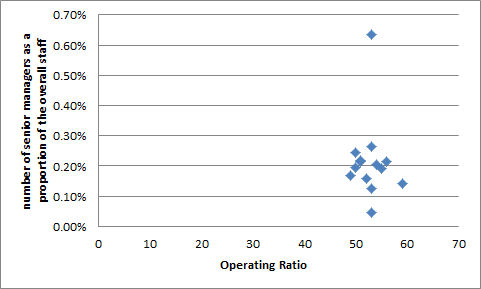
While information on the railway companies’ financial performance is easy to find for the entire 1870- 1914 period, employment data is a bit more elusive. The only year from which accurate data is available can be found is 1884, when the companies submitted a return of how many individuals they employed in all grades to the government. Thus, for this blog post I will look at the link between the number of managers companies’ had and their profitability in 1884 in Britain’s 14 largest railway companies. The central measure of company efficiency is the Operating (OR), which measures the company’s expenditure as a proportion of revenue. Thus, while imperfect, it does give some indication as to corporate performance. This will then be measured against the number of senior managers and administrators the companies’ had as a proportion of their total workforce, and also against the number of managers and administrators they employed per route mile operated.
Firstly, I looked at the OR against the number of senior managers as a proportion of the overall number of staff. This is shown below:-

As can be seen, there is no discernable correlation between how many senior managers the company employed to administer the staff and company performance. The one return that is out of place was the Taff Vale Railway, in which 0.63% of all employees were managers, a fact probably reflecting its smaller size.
I have then expanded the sample to include all the companies’ ‘administrators.’ By this I meant all the individuals that had a chance to go into management, such as clerks, station masters and inspectors. Thus, the next graph shows the OR against the number of administrative staff as a proportion of the companies’ total workforce:-

Once again, there is seemingly no strong correlation between the size of the management class proportional to the companies’ total workforces and the performance of them.
However, on discovering these results it didn’t conclusively prove that in 1884 the number of managers affected company performance. So, I wanted to take this further and decided to look at the number of managers per route mile open against the OR. The graph below shows this.

Again this reenforces the fact that the number of managers within companies did not affect their ORs in any real sense. The one ‘high’ figure was the Midland railway which seemingly had a very large number of senior managers per route mile operated (69.40). Contrastingly, the Taff Vale Railway, which had the same operating ratio of 53%, had the lowest number of managers per route mile operated (4.57).
Lastly, I looked at the number of administrators per route mile open against the OR. This is shown in the last graph below.

This is probably the graph that has the highest level of correlation between two data sets that I have chosen, showing, very weakly, that as the number of administrators per route mile open increased, so did the operating ratio. However, given what has been discovered above, I cannot conclusively say that incereased administrators per route mile increased the operating ratio.
Overall, what my very quick piece of research has shown is that in the very largest companies in Britain in 1884 the size of an organisations’ established executive and management class had almost no affect on their profitability. Companies with larger managements proportional to the staff or per route mile did not seem to gain from this fact, whereas those with smaller ones did not suffer devistating efficiency losses. Therefore, this suggests that by 1884 railway companies appointed managers based on the needs of operation and not based on an internal logic that dictated that increased management meant increased profit. It further suggests that in 1884 that British railway companies were not ‘top heavy’ in that they had too many managers.
Conversely, it has been well documented that 19th century Britishrailway companies’ were over-centralised, a factor that meant the numbers of senior managers in the industry was small proportional to the total workforce. Thus, what this evidence cannot show is whether significantly increased numbers of managere may have had an affect on companies’ performance in the long run as I have essentially measured the companies against their piers. Indeed, the fact that British railway companies managed themselves in very similar ways means that these figures may be of more use if compared with railways in other countries. Naturally, as with all things I post, this area of work needs more research...
Jumat, 31 Desember 2010
The Riots and Brawls of the Victorian Railway Navvy
The railway navvies, the men who built the railways, were well known as being thieves, rioters and susceptible to the evils of drink. As railway building progressed, and the number of navvies grew, anti-navvy sentiments were aroused. The London Pioneer of December 1847 distinguished between the ‘open, kind-hearted, civil and hardworking’ navvies of the very early years of railway construction, and the influx of newcomers that they dubbed and ‘inferior race of men.’ A Mr Robinson wrote in an article that “they were so excessively drunken and dissolute, that a man would lend his wife to a neighbour for a gallon of beer, and that it was difficult to conceive a set of people more thoroughly depraved, degraded and reckless."[1]Of course, their demonic status was invariably overstated, however, navvies were in large part responsible for crimes and riots around the nation, and the fact that they moved with the construction of the line, from place to place, must have meant that for many they were a roving band to be feared. Indeed, Terry Coleman, in his seminal book on navvies, reported that communities in Scotland began to live in fear as ‘navvy riots were habitual.'[2]In this blog post I will look in brief at the disturbances that were caused by navvies between 1840 and 1850.
Of course much of the trouble that navvies caused was local and somewhat insignificant. On Thursday 19th March 1846 the The Bradford Observer; and Halifax, Huddersfield, and Keighley Reporter reported that on the Saturday before, in Castlegate, a navvy by the name of Christopher Brown had knocked over an unnamed girl, fracturing her jaw in two places. A William Walker came to her defence and he also was knocked down, receiving a kick to the face from which he suffered a bloodied lip. Both were admitted to the infirmary soon after. However, when on his way back home Walker saw Brown again and was floored a second time. This time Brown did get away with the crime. A police constable was in attendance and took him into custody and he was subsequently committed to two months hard labour.[3]
Yet, on occasion navvies banded together to terrorise local populations. On the 7th March, 1846, John Bull reported that at some point between Saturday the 28th February and the Sunday of the 1st of March a ‘breach of the peace of a most daring kind’ was committed, attended by a murder. Near the North British Railway’s line to Hawick, about 11 miles south of Edinburgh, two navvies were arrested at around midnight as they were suspected of stealing a watch. Soon 300 navvies had gathered, armed with ‘bludgeons, pickaxes, hedgebills &c’ and headed towards the police station to liberate the accused. On reaching it, one of the navvies held a pistol to the sergeant’s head and demanded their comrades’ release. He refused, and subsequently the mob broke open the cell and released their compatriots. In their march towards their workplace, the local Fushie Bridge, they encountered the district constable, Pace, who they savagely attacked leaving his skull smashed open. He died on the Sunday afternoon. Thus, in response to this attack, List, a local police officer, had a force of men put at his disposal and succeeded in apprehending 13 of the rioters in the course of the Monday.[4] Their fate was unknown.
Yet apart from terrorising the local residents, Navvies also had a pinache for antagonising each other. In Bell's Life in London and Sporting Chronicle on June 7th, 1846, it reported under the heading of ‘Saving trouble,’ that two navvies on the construction of the Marley Tunnel in South Devon were ‘resolved to decide a quarrel by a stand-up fight.’ Once stripped and ready to fight, the quarrel was decided by virtue of the fact that one of the men ‘fell down dead before a blow was struck.'[5]
Yet, inter-navvy hostilities were much worse in many cases, with conflict arising from matters of religion, pay and antagonism between different groups of workers. After all, one third of railway navvies were Irish, another third were Scottish and the last third were English.[6] With many Irish Catholic navvies working in Scotland there was bound to be conflict with the Scottish, predominately Protestant and Non-conformist, navvies. As Terry Coleman stated, Irish labourers did not look for a fight, however two things vexed their Scottish compatriots. Firstly, they worked for less pay than local labourers. But in addition the devoted Catholic Irish regarded ‘the Sabbath as a day of recreation on which thy sand and lazed about,’ when the Scots still worked and only required some quiet prayer time and a drop of whisky. Thus, the Irish were attacked and beaten up by their Scottish co-workers. Railway contractors tried to keep Scottish and Irish navvies apart, but to no avail. All the while, British navvies, in Coleman’s opinion, assembled and fought with anyone, although they generally preferred to attack the Irish. These riots were widespread in the 1840s, and fights would sometimes include up to 2000 navvies.[7]
Of course, what was reported in the newspapers were the worst and most notable examples of navvy violence, and I suspect that in many cases the majority of navvies were law abiding, peaceful and hardworking. However, it is clear that on many occasions navvies did fight, did commit crimes, and were a menace where they worked. This said, to what extent this was the case has not been looked at quantitatively, and much research has to be done on the way that navvy communities, which included their families, interacted with their environment. Of course Terry Coleman’s book is a useful guide; however his book is rather anecdotal. Subsequently, this is an area of railway history into which I wish to look further in the future.
-----------------------
[1] London Pioneer ,Thursday, December 17, 1846; pg. 536; Issue 34
[2] Coleman, The Railway Navvies, p.93
[3] The Bradford Observer; and Halifax, Huddersfield, and Keighley Reporter, Thursday, March 19, 1846; pg. 5; Issue 611
[4] John Bull , Saturday, March 07, 1846; pg. 158; Issue 1,317
[5] Bell's Life in London and Sporting Chronicle, Sunday, June 07, 1846; pg. 8
[6] Coleman, Terry, The Railway Navvies, (London, 1976) p.93
[7] Coleman, The Railway Navvies, p.93-95
Selasa, 21 Desember 2010
Railway Company Staff Records - What Survives from the L&SWR
Staff records can be classified into three categories (well in the L&SWR’s case at least). Firstly, it is important to note that within all 19th Century railway companies there were two employment streams, the clerical and secondary labour markets. Those clerks in the clerical labour market had to go pass rigorous entrance requirements and tests, but once employed enjoyed good promotional prospects, salaries that were paid to them monthly and job security. Indeed, many clerks became senior managers. The secondary labour market encompassed all other staff. Most were paid weekly, had poorer wages than clerks and had low job security. Thus, it is only natural that the staff records of these two employee groups are different in character. While in both cases individuals’ details were either recorded on a full or half page of a book, the clerical staff’s details were usually recorded in a larger book, but, surprisingly, had fewer forms of information within. Lastly, in addition to these records, there were the ‘registers of workmen’ that recorded the details of many individuals over two pages.
Clerical staff registers, in the case of the L&SWR at least, have a separate index which is very handy when looking an individual up. Five pieces of information were recorded on the clerical staff registers held at the National Archives. These were the age of the individual when they started their employment, date of entry into the service, who nominated them for a clerical post, any ‘positions and removals or promotions’ and ‘reports and complains.’
A couple of things stand out about from these records that should be noted. The individual who nominated them for a clerical position was usually either a senior manager within the company or a director. However, ordinarily they would have been written to by a ‘respected’ individual who knew the prospective clerk, for example a school teacher, religious figure or a local dignitary. In the section recording ‘positions and removals or promotions’ was recorded all the details of an individuals’ pay at certain points and the length of time they spent at different locations. On many occasions, their post-employment details, such as their pension and date of death were also recorded. Lastly, the records detail any ‘reports and complaints.’ This encompassed any time a clerk did something exemplary in the line of duty, or did something which would warrant punishment. Punishments included fines, demotion or, in worst case scenarios, dismissal. For example, in February 1892 T.H. Jebbitt, the Agent at Basingstoke, was called upon to resign because of ‘irregularities in various cash matters.’ (shown below) What these irregularities were is not noted in his staff record, but it is at the point that the diligent researcher would seek out the Traffic Committee minute book to find out.
The staff records of those in the secondary labour market usually have more information contained within them. Unfortunately, despite this bonus, in the case of the L&SWR there is no index which means that finding an individual is a laborious task involving searching through every record. What’s more, in the case of the L&SWR many staff records are missing, and only some individual personnel files from the Traffic Department have survived. The information for which there spaces on the record are the staff member’s date of birth, height, the ‘number of the testimonial,’ address when appointed, who recommended them, their date and place of appointment, grade, starting wage, marital status, any remarks, whether they passed the eyesight test and their promotions or wage increases.
Clearly, the larger amount of information recorded was because many in the secondary labour market, such as cleaners, platelayers or porters, were doing more arduous and labour-intensive work. Thus, more details furnished as to their physical appearance and attributes so that their suitability for the job could be assessed. However, what has been noticed is that on many occasions not all the information was filled in, presumably because of the nature of individuals’ jobs. For example, Mrs Watkin (below) was appointed as a waiting room attendant and because the job was not that labour-intensive many of the details have not been filled in.

The last form of employee information was the staff registers that listed the details of many L&SWR employees consecutively (below). However, because so many individuals were listed on two pages the information furnished is not as detailed as in individual staff records. However, a positive thing about the staff registers is that they usually had an index at the front from which individual employees could be found within them. As far as the L&SWR is concerned, only staff registers from the Locomotive Department have survived at the National Archives and the Hampshire Record Office. They record, the employees’ ‘register no.’ (which presumably linked to an actual person’s record), their names, their occupation, where they were employed, the date they entered the service, their starting wage, any wage increases and lastly any remarks. Yet, what the registers do not record, as far as can be seen, are any promotions, rewards or disciplinary actions. Thus, these can be somewhat frustrating files for the historian because of the limited information contained within them
It should be recognised that what I have detailed here only applies only to the L&SWR, and the other railway companies may have set out and organised their staff records differently. Irrespective of this, the staff records of railway company employees are a really useful source for all historians, even if they can be frustrating a lot of the time.
Sabtu, 18 Desember 2010
A Little Book of Treasures - A Discovery at the National Archives
On it arriving in my locker, I quickly realised this document fell into the latter category. At about 3 inches across, and 6 inches high, this unassuming book contains the weirdest and wonderful collection of information on the L&SWR that I have ever found. The content is all handwritten and there is no overriding theme. I am pretty certain that it comes from a member of the L&SWR’s Locomotive Department, as most of the information is of a ‘Locomotive Department’ nature, and the details cover the period 1903 to 1918. Because of this item’s odd nature, I thought I’d share some interesting snippets.
I thought I’d start on the first page which lists the ‘rates of pay of mechanics’ at the Eastleigh Locomotive Works in March 1918. Firstly, it is noted that mechanics on average worked for 50 hours a week. This wasn’t an unusual length of time to be working in 1918, but it would have been less than their predecessors who may have worked up to 70 hours a week. Of the 41 positions within the works listed the highest paid were the Foregemen, who earned 46 shillings and 6 pence per week or £120 18 shillings year. Lowest paid were the Hammer drivers, who earned 18 shillings a week or £46 16 shillings a year. At the bottom of the page is also found information on apprentices, who were supposed to receive ‘full journeyman’s rate’ (whatever that was) and were to receive half yearly increases until they had completed their apprenticeships.
Like all railway companies, the L&SWR had a considerable increase in traffic in the 1890s. On page 16, from around 1905, an effect of this traffic growth is shown, as the author noted the increase in the engine and train miles that the company ran between 1895 and 1905. In 1895 L&SWR trains ran 15,315,290 miles, whereas in 1905 they ran 18,549,609 miles. Yet, these figures did not include the distance that the locomotives individually travelled, as this was longer and included trips to engine sheds, running around trains and any maintenance work. Thus, in 1895 L&SWR locomotives moved 21,291,938 miles, but by 1905 this distance had increased to 27,769,668 miles. But, the increase pressure on the company’s services could only accommodated by expanding the locomotive stock, and between 1895 and 1905 the locomotive stock jumped from 664 to 736 locomotives. Further to this, the author made a note on the L&SWR’s future locomotive requirements, saying that the locomotives already built would be sufficient for, at most, 8 years. This shows that by this time forward planning was a part of railways’ decision making process. Yet, like all businesses, this was a guess. As such, the author stated that a worst case scenario, new locomotives may be needed after only 5 years.
From around 1908 or 1909, on page 24 is the quite odd note titled ‘the life of a tree.’ This indicates that it wasn’t just the type of wood that was interesting this individual or the locomotive department. Rather, woods' lifespan was also of interest. The author received this information from the Washington Forestry service, showing that Anglo-American communication was active. Therefore, Pines lived a maximum of 700 years, Silver Firs 425 years, Red Beaches 245 years, Aspens 210 years, Birches 200 years, Ashes 170 years, Elders 145 years and Elms 130 years. The reason for the author to collect this information is unknown, but I guess that it may be associated with what wood the Locomotive Department chose when undertaking different woodworking activities.
On page 87 there is a list of the different prices that the L&SWR paid for water at different locations in January 1912. Interestingly, it shows that local economic structures may have played an important, and probably unpredictable role in a company’s costs, as water was provided by local water companies whose prices varied hugely. So, for example, at Waterloo, the company paid 6 1/8 pence per 1000 gallons, while at Wadebridge in Cornwall they paid 4 ½ pence per 1000 gallons, and at Bishops Waltham, in Hampshire, their bill was a massive 1 shilling per 1000 gallons. In this period, there were no large water companies that could set national prices which would have enabled the L&SWR to predict each year what the cost of water would have been better.
On page 102 is probably my favourite entry in the book. It details at an unknown date terms of employment for engine cleaners. I think, instead of paraphrasing the text, I will just replicate it here. Boys ‘Must be between 16 + 18 years of age, of good physique + have been vaccinated. Must not be less than 5’ 4” at 16 years of age + 5’ 5” @ 18 years of age. Must pass eye exam + exams in arithmetic up to and including the rate of three. Must live within easy walking distance of their work, but engine cleaners appointed at Nine Elms are eligible for free residential tickets and must live within a radius of 12 miles.’
The joy of this book is that it does have little snippets on many forms of railway history, whether they be technological, scientific, social or managerial. It could, therefore, add much to the PhD and I look forward to getting stuck into it. However, the downside is that the document will take a lot of time to truly get through and understand. Whoever the author was, I accept his challenge.
Jumat, 10 Desember 2010
Female Railway Clerks at the LSE, 1914-1920
In the first term (1903-04) the courses available were 'The Economics of Rapid Transport,' 'The Law Relating to Railway Companies,' 'Economic Factors in Railway Administration,' 'Railway Statistics in England and Foreign Countries' and 'The Law of Carriage by Railway.' All initially ran for 3 to 12 lectures, and a student’s performance was measured by either an essay or exam. The number of courses made available by the Railway Department soon expanded, and by the First World War topics included railway engineering and locomotive operation. Further, courses were also offered on subjects not directly related to railway management or more general topics, such as economics, business and accountancy skills. Ultimately, students who attended over many years could obtain a degree with honours in transportation.
Over this period, the number of female clerks working within British railway companies had grown significantly. By July 1914, out of 13,046 female railway workers across the network, 2,341 were working in clerical grades. With the coming of the war this number increased. Thus, by 1918 Britain’s railways employed 13,655 women as clerks.
Throughout the war the Railway Department at the LSE continued to teach London-based clerks and many female clerks took the opportunity to attend. In total, over the period 1914 to 1920, there were 126 occasions of female clerks attending the Railway Department for a term. In contrast there were 1419 occasions of male clerks attending for a term, meaning that over the period women made up 8.16% of the student body.
The evidence shows that the attendance of female clerks was shaped by women’s wartime employment patterns. Thus, in the 1914-15 term there were no female students (out of 267), as the proportion of women within the railways’ clerical workforce was still insignificant. It was in the 1915-16 that the first female clerks attended the LSE, one coming from the Metropolitan Railway and four from the Great Western Railway. From this small start, and with the massive increase in the female clerical staff generally, the number attending the LSE grew after 1916. This growth is tabulated below:-

What is also interesting is that female clerks working on the different railway companies attended the classes in different proportions relative to the number of overall attendees that their company sent. The table below shows the number of clerks that attended according to the railway company with which they were employed between 1914 and 1920:-

Evidence suggests that the enthusiasm with which female clerks from the different companies attended the LSE may have been influenced by the companies’ pre-war enthusiasm for employing women in clerical positions generally. Therefore, the Great Western Railway, who supplied the greatest number of female clerks relative to their entire contribution to the student body, was one of the first companies to employ women as clerks in 1906. Yet, one of the railways from which the fewest numbers of female clerks went to the LSE, the London and South Western Railway, only began to employ female clerks in March 1914. A caveat should be stated, in that these figures will be affected by the fact that the LSE classes were only attended by clerks that worked in the London area. So, for example, the worst performer in the table, the Great Northern Railway, served mainly areas in the north of the country and may have had few London-based female clerical staff, which would have affected their returns.
Yet, despite this consideration, the evidence suggests that the different companies’ pre-war mind-sets towards female labour and employment may have affected the encouragement that they gave to their female clerks to attend. Indeed, if senior managers within some companies had only begrudgingly allowed women to become clerks in the first place, it is quite possible that they did not make them aware of the courses at the LSE or put up barriers to them attendening. Indeed, the L&SWR employed over 400 female clerks during wartime, yet only 2 attended the Railway Department, suggesting that something restricted their attendance.
Clearly, this story shows that the attitudes of higher education institutions to the education and admission of women was changing. But more importantly, it indicates that once given the opportunity to attend these institutions, women did so with enthusiasm.