Senin, 14 Februari 2011

One Year of Blogging - What I have learnt so far

This, would you believe it, is my first anniversary Blog post. Over the past year I have touched on topics as diverse as religion in railways, right through to modern railway issues. I can’t say I have thoroughly enjoyed every moment of the process, and at times I have struggled to find something to say. However, it has been rewarding, inspiring and useful to me. I hope that you, dear reader, have also enjoyed my posts and will continue to follow my blog in the year ahead. In this post I hope to touch on some of the things that I have learnt in the process that will, hopefully, improve my blog in the future.

I am not a miracle-man – No, sadly I am not. In around September and October I started to write a blog post every other day. My goodness, it was a mistake. Not only did I rack my brains constantly for things to say, but I found that my other work, the PhD, began to suffer. The main thought behind starting the blog was that I wasn’t time burdened with teaching classes, something that full-time PhD students usually do. Thus, the blog would naturally fill this space. Yet, writing seven blog posts per fortnight was too much, even though it did have a positive effect on the number of hits I received.

People are more interesting that Management – Well, this one took a while to realise. I am by default a railway historian but my PhD is placed, quite naturally, under the banner of ‘business history.’ Thus, most of my material in the early days of the blog was of a managerial bent. I realise that sometimes I still post things of this nature, but I do see in the statistics that they are not as popular. Thus, in September or October I started writing more about railway employees, as these posts invariably attracted more attention. This policy has subsequently met with much success.

Don’t start a boring side-project– Does anyone remember ‘Turniprail +Documents?’ I have a very large collection of railway documents from railway history which I find fascinating. Thus, I started the ‘+Documents site’ as a way to show them off and by proxy promote my main blog. This site monumentally failed as virtually no one looked at it. Presumably, everyone wasn’t really interested in my documents and I suppose as the ‘historian in the room’ it was my job to interpret their contents and write something interesting about them. Unsurprisingly, I ended the project very quickly.

My interest is not everyone’s – If you could only see my cutting-room floor. I have posted entries on the blog that were much longer in their first draft because I wrote parts that I alone found interesting. If you look back at my early posts you will see this. However, I soon came to realise that putting in too much irrelevant detail can be stifling for the reader. This doesn’t mean I have stopped doing it. However, I can now identify the boring parts and catch them before they get on the site.

Social Networking is a great, but Google is better – Many of you are no doubt reading this because I either posted this article on Twitter or my Facebook group. That’s great, and many thanks for following me, I do value it. However, as the number of posts has risen, so have the hits that I have received from search engines. Over the year they have provided me with a third of my traffic, yet, in the last month they constituted half. Thus, people are finding the site and my work because I am now becoming an internet presence. I suppose this percentage can only go up.

Referencing is Important – I am not entirely sure whether any the information on my site has been used in books or articles elsewhere (and please shout if it has). However, I have come to the realisation that referencing my sources in my posts is highly important. Firstly, I want what I write to be used by historians elsewhere. Secondly, I don’t just want this site to be something that forgotten by historians when I stop adding to it. I want it to be a resource for many of them in the future. As such, I now reference everything so that the posts are taken seriously academically and will also stand the test of time.

One Document can be interesting – I still sometimes write highly involved pieces where the references are coming out of my ears. Nethertheless, I have learnt that simply using one document for a post can be the path to getting it out when time is at a premium. More importantly, blogs on individual documents can also be equally as interesting as multi-sourced ones.

Of course, this isn’t everything I have learnt over the past year, to write that list would be laborious. Yet, these are my central revelations that I will hope will improve my blog in the future. Lastly, all that remains to be said is to thank you for reading my work…and here’s to the next year!

Jumat, 11 Februari 2011

Public Opinion and Railway Managers - A Victorian Case Study

In my work on the London and South Western Railway (L&SWR) I am acutely aware of the fact that after 1870 the railway company’s business was affected by external forces such as rising costs, government legislation on safety, fluctuations in the trade cycle and the growth of unions. Indeed, much of the literature on the late 19th century railway industry has focussed on how these factors affected companies’ profitability. Another area of interest is the effect that public opinion had on companies and whether they may have tailored their services to the needs of the public, rather than engaging in ruthless profit maximisation. However, rarely has this been studied in detail. Thus, it was with this in mind that I decided to have a look at The Times online archive to ascertain whether I could find linkages between public opinion of the L&SWR and its policies. I did in part, but my discovery wasn’t what I expected, in that I found a storm that was blowing around one man.

Archibald Scott was born in Dundee in 1821 to a Tanner, also by the name of Archibald.[1] Information Scott’s early life is unknown, apart from the fact that he was employed by the Edinburgh and Glasgow, Edinburgh, Perth and Dundee, and North British Railway companies. In 1852 he was appointed as Traffic Manager of the L&SWR, after the previous holder of the post, Cornelius Stovin, absconded to the United States with a fair amount of the company’s money. In 1870 he was promoted to the position of General Manager with control over all the company’s operations.[2] Thus, by 1884 Scott had been the company’s most senior manager for 32 years.

From the mid-1870s the complaints against the speed and unpunctuality of the L&SWR’s train services began to grow. The May 1876 issue of The Pall Mall Gazette published a letter from ‘Quaerens’ complaining that the L&SWR, amongst other companies, halted the regular trains in favour of ‘specials’ bound for the race meetings at Epsom and Ascot.[3] In an edition of Funny Folks magazine of October 1878, it mentioned the case of a season ticket holder who had brought an action against the company because of delays to his journey. He lost his case, which the publication lamented.[4] In September 1880 a letter to The Standard from a ’victim’ complained that the ‘unpunctuality of the [L&SWR’s] trains was notorious’ and that he ‘had never in my life arrived at Waterloo at the proper time.’ He placed the blame at the feet of the management.[5] Lastly, in the late 1870s the residents of Hounslow formed an ‘Acceleration Movement Committee,’ and under the leadership of Peter Watson they frequently petitioned the company for improved train services. In some cases, trains arriving at Waterloo arrived 20 to 30 minutes late.

Many of the delays in the train service can be attributed to the fact that between 1870 and 1880 the company’s passenger traffic increased by 126%. In 1870 the company hauled 13,387,357 passengers. By 1880 this number had risen to 30,294,406, and this caused the infrastructure of the company to come under strain, especially at bottlenecks in the system like Waterloo. The lines into that station were narrow and the station was small, only possessing four platforms in the mid-1870s. The company attempted to ease the pressure by expanding the station in 1878 and 1885, adding a further eight platforms.[7] Yet, these changes were unsuccessful in slowing the steady flow of complaints about the company's train services. As always, the blame was laid squarely at the feet of ‘the management.’[8] Then in late 1884 a storm broke.

It is where this storm broke that was important. It was in the country’s most prominent newspaper, The Times. On the 9th October five prominent passengers, Lieutenant-Colonel S.E. Orr, Colonel Clifford Parsons, Lieutenant-Colonel R.H. O’Grady Haly, Edward H. Halsey J.P. and George Fry, wrote to The Times to complain about the unpunctuality of the L&SWR’s train services. All lived about 35 miles from Waterloo and travelled on the same train daily. While according to the timetable they were expected to arrive at 10.24, they always arrived later, sometimes after 11 am.[9] This was followed on the 11th October by another letter from D. Radford who complained about the ‘extreme unpunctuality’ of the company’s services.[10] On the 16th three more letters were published from ‘A Resident,’ ‘A Victim’ and ‘Viator.’ The ‘victim’ laid the blame for the unpunctuality of trains at the feet of ‘the utter incapacity of the management of the London and South Western Railway.’ But it was not all criticism, and while the ‘Resident’ did acknowledge the problems, he defended the company on the grounds of that increased traffic had caused the delays in trains. Also, ‘Viator’ was positive about trains on the ‘Thames Valley Line,’ (to Shepperton) stating that were never more than 10 minutes late.[11]

However, any defence of the company was quickly nullified by the letters that the paper printed on the 21st October. Of six letters printed only one supported the company, with almost all attacking the unpunctuality of the company’s trains. Indeed, the first, from H. Stopes, went further in criticising officials at Waterloo who he claimed were ignorant and lacking in courtesy. Lindo S. Myers stated that he had travelled in Europe and that ‘there is not one [company] so badly managed as the South-Western nor is there any time table which is so purely the work of supposition.’ The only support for the company came from J.M.D. who stated that the trains between Exeter and London were always punctual.[12] Yet, this defence was called into question by a letter printed on the 23rd October in which H.T. Edwards wrote that the punctuality on this service proved ‘that even the London and South Western can be punctual when they come into competition with the Great Western.’ He called this fact the ‘last nail in the coffin’ for the ‘disgraceful management’ of the L&SWR.[13]

What effect this had on the L&SWR General Manager is unknown. However, it cannot be a coincidence that on the 10th November, only two and half weeks after the last complaint in The Times, Scott sent a letter to the L&SWR board tendering his resignation.[14] While other factors may have been involved in this decision, such as the worsening financial situation of the company and Scott’s increasing age, the high profile nature of the complaints, combined with the increasingly poor image of the company because of them, no doubt helped Scott decide that it was time to go.

Therefore, this case overall raises the question as to the extent external pressure played in shaping the careers of Victorian railway managers and the decisions they made. This, subsequently, is an area that needs more work.


[1] The National Archives [TNA], Unknown Reference, 1841 Census Return, Dundee, Forfarsh, p282

[2] TNA, ZPER 11/28, South Western Gazette, January 1911, p.8

[3] The Pall Mall Gazette (London, England), Monday, May 22, 1876; Issue 3512

[4] Funny Folks (London, England), Saturday, October 26, 1878; pg. 338; Issue 204

[5] The Standard (London, England), Wednesday, September 15, 1880; pg. 3; Issue 17521.

[6] Williams, R.A., The London and South Western Railway – Volume 2: Growth and Consolidation, (Newton Abbot, 1968), p.48

[7] Chivers, Colin and Wood, Philip, Waterloo Station circa 1900: An Illustrated Tour – South Western Circle Monograph No.2, (London, 2006), p.2-17

[8] TNA, ZPER 11/3, South Western Gazette, December 1884, p.3

[9] The Times, 11th October 1884, p.7 Issue 31262

[10] The Times, 15th October 1884, p.7 Issue 31265

[11] The Times, 16th October 1884, p.10 Issue 31266

[12] The Times, 16th October 1884, p.12 Issue 31270

[13] The Times, 23rd October 1884, p.12 Issue 31272

[14] TNA, RAIL 411/7, Court of Directors Minute Book, Minute No.1547, 13th November 1884

Rabu, 09 Februari 2011

Do You Really Want To Change?

This is a great phrase on change from my coach Joe Stumpf. Hope you enjoy!

Feb 08, 2011
When you say, “I want to change,” what you’re really talking about is your habits. The habits are conditioned in your childhood. Even more ingrained are the habits that come from the deep, evolutionary, primitive past. You know from our past conversations that the most primitive habit is to survive. It’s to stay safe. It’s to be secure.
The habit of creating a safe and secure, fully comfortable life that limits risks helps us hide our authentic power behind a mask called “play it safe.”

Yet, it’s true that your most important personal growth occurs outside your safe comfort zone. We grow personally when we step up and we take intelligent, healthy, risks.
Actually, you know in your own experience that the real juice in life is when you take off the “play it safe” mask and you allow yourself to be energized by the challenge.
But many times, have you caught yourself wanting and hoping for an easier, softer way or simply allowing security and circumstances to determine your challenges versus really seeking your security? I mean, truly seeking your security in playing a bigger game and making your life all about stripping the mask away and truly revealing your authentic power?
Imagine living a life that its purpose is to live authentically every moment.
Imagine that.
Imagine waking up and your purpose is to live a life authentically every moment. What kind of power would that take? I would call it authentic power.
Authentic power is something that no one can give you. No one can make it happen for you. You must do the work to bring it out of you.
You can hang around people who demand authenticity, but they can’t do it for you because authentic power is when you are guided by your own awareness, your own mindfulness, your own intentions, and that you consciously choose – with compassion, and empathy, and wisdom – to access your authentic power.
My hero’s journey into this world of personal growth has been about finding – and changing – the parts of my personality that do not intend for me to be authentically powerful.
How many of you can recognize there are parts of your personality right now that do not intend for you to be authentically powerful?

Senin, 07 Februari 2011

Ministering to Navvies - Railways, Religion and Combating the Labourer's 'evils'

I have talked in the past about looking at the relationship between religion and the railways, as the way that religion interacts with society and the structures within it is something that fascinates me. Therefore, when I came across the government’s 1847 select committee report on Railway Labourers it didn’t surprise me that their religion, or lack thereof, was something that concerned the committee members.

The committee was formed to ‘inquire into the Condition of the Labourers employed on the construction of the railways and other public works, and into the remedies which may be calculated to lessen the peculiar evils, if any, of that condition.’ [1] Seemingly, the commons did not see the error of putting ‘if any’ [italics added] in the terms of reference, as there would have been no reason to form the committee if railway labourers were perceived to by sober, polite and pious. Indeed, as I have written in this blog previously, railway labourers and navvies had a reputation for being drunkards, brawlers and semi-criminal.[2] Thus, in a Christian country, where clean living was seen as highly important for the health of one’s body and soul, railway labourers were perceived as heathens. This is why the committee too such an interest in their religious activities.

The committee took evidence from many individuals, including such notables as Isambard Kingdom Brunel, the famous engineer, Samuel Morton Peto, the owner of one of the largest contracting firms in the country, and Captain Constantine Richard Moorsom, a director of many railway companies and later chairman of the London and North Western Railway. Furthermore, the committee also interviewed builders, other contractors, railway employees and clergy that dealt with railway labourers. Thus, when writing their final report they had evidence from many quarters.

The report stated generally that religious provision for labourers was ‘imperfect.’ Large communities of railway labourers were established very rapidly when a new line was under construction, putting a strain on local religious facilities. This problem was especially acute in areas where the population was sparse. As such, the committee concluded that this deficiency cooperated with other evils to ‘deprave the character and degrade the habits of the men.’ Therefore, it is unsurprising that many of the individuals who stood before the committee felt that some form of religious instruction was beneficial for reducing the ‘evils’ that the labourers engaged in.[3] To make up for the deficiencies some railway and contracting companies did provide out of their own pocket religious facilities for the labourers engaged on building works. However, the level of provision varied between them. Some companies provided religious personnel to minister to the labourers. The Caledonian and Liverpool and Bury Railways,[4] as well as the contractor Peto,[5] paid for a number of scripture readers. The South Devon and Caledonian Railways paid for chaplains.[6] However, some companies went further and provided their labourers with venues for religious activities. On the Chester and Holyhead railway the company ‘temporarily fitted up a church’ at Chester. The Lancashire and Carlisle and South Eastern Railways built temporary chapels at Penrith and Dover respectively. The most minimal provision was made by the Sheffield and Manchester Railway who provided their labourers with a ‘hut covered with a tarpaulin.’ Lastly, Peto’s contracting firm provided his employees with Bibles as standard.[7]

However, despite these companies’ efforts, the report itself stated that religious provision was ‘utterly neglected.’[8] Officials from the North British, Norwich and Brandon, and Manchester and Leeds Railways stated that while they were aware of places of worship near their building works, the companies themselves did not provide any religious facilities. Subsequently, the report concluded that where labourers only had local religious provision attendance was varied. Labourers on the Chester and Holyhead railway attended the churches and chapels in Conway greatly, while workers employed on the Manchester and Leeds Railway’s Oldham branch did not.

Furthermore, only in the cases of the South Devon and Caledonian Railways were full priests, vicars or ministers provided for the labourers.[9] Indeed, it seems that many of the companies relied on local clergymen or religious organisations to take an interesting the spiritual wellbeing of the labourers. In the case of the South Devon Railway it was the Reverend John Robert Thompson that approached the company to minister to them because of the disturbance they were causing amongst the local population.[10] The Croydon and Epsom Railway’s employees were ministered to by the local Pastoral Aid Society and the Leicester and Carlisle Railway’s labourers had a layman employed by the ‘Dissenters of Kendal.’ Furthermore, the Irish labourers from the Caledonian Railway actually paid for a Roman Catholic priest to visit themselves. However, this was presumably because of the lack of Roman Catholic clergy in the area.

Additionally, while only Peto provided Bibles as a matter of course to his employees, on the Chester and Holyhead and Lancaster and Carlisle Railways the workers could buy them, as well as hymn and prayer books.[11] Therefore, it seems that the religious instruction that was provided by the companies was variable and was possibly affected by who was in charge of the company.

Overall, while the committee concluded that access to religious provision did have a ‘most satisfactory’ result in combatting ‘evils’ amongst railway labourers,[12] it also stated that this was no substitute for companies addressing their underlying causes. These included the level of wages paid, the regularity of payment,[13] the housing provision for them and their families, the rapid movement and growth of labouring communities,[14] and the conditions in which they worked.[15] Thus, in the committee’s final report the lack of religious provision for workers was cited last as a cause of labourer’s disruptive behaviour. Indeed, the presence of religious instruction was seen only as bonus in solving the problems of labouring communities, rather than a cure. The report stated that ‘no teaching can be of much avail to counteract the ceaseless operation of such degrading and deteriorating influences,’ and that in trying to improve labourer’s behaviour employers had understandably improved other aspects of their lives.[16] Furthermore, amongst the statements provided to the committee the evidence that religious instruction had positive effect on labouring communities’ ‘evil’ habits is seemingly very weak.

--------------

[1] House of Commons Parliamentary Papers [HCPP], 1846 (530) Report from the Select Committee on railway labourers; together with the minutes of evidence and index.

[2] Coleman, Terry, The Railway Navvies, (London, 1968), p.19-35

[3] HCPP, 1846 (530) Report from the Select Committee on railway labourers., p.xi

[4] HCPP, 1846 (530) Report from the Select Committee on railway labourers., p.40

[5] HCPP, 1846 (530) Report from the Select Committee on railway labourers., p.43

[6] HCPP, 1846 (530) Report from the Select Committee on railway labourers., p.11

[7] HCPP, 1846 (530) Report from the Select Committee on railway labourers., p.40-41

[8] HCPP, 1846 (530) Report from the Select Committee on railway labourers., p.xi

[9] HCPP, 1846 (530) Report from the Select Committee on railway labourers., p.40-41

[10] HCPP, 1846 (530) Report from the Select Committee on railway labourers., Minute 179

[11] HCPP, 1846 (530) Report from the Select Committee on railway labourers., p.40-41

[12] HCPP, 1846 (530) Report from the Select Committee on railway labourers., p.xii

[13] HCPP, 1846 (530) Report from the Select Committee on railway labourers., p.iii

[14] HCPP, 1846 (530) Report from the Select Committee on railway labourers., p.vi

[15] HCPP, 1846 (530) Report from the Select Committee on railway labourers., p.viii

[16] HCPP, 1846 (530) Report from the Select Committee on railway labourers., p.xi

Sabtu, 05 Februari 2011

We Need to Act Now to Save Railway Archives

The railways of Britain are probably some of the most studied organisations in the history of the world, with tens of thousands of enthusiasts nationwide researching and writing about them each year. These enthusiasts have been invaluable in advancing our knowledge of Britain’s railways and their operations, and have shed light on many areas of railway history that have previously been unknown. Indeed, my own work has been immeasurably enhanced by the London and South Western Railway’s study group, the South Western Circle, whose membership has provided me with documents, articles and pieces of research. In fact, such has been their contribution to my work that they get a big credit in the introduction to my PhD. But the Circle is only one part of a network of study groups across the country that research individual companies and lines. However, within this community there is an approaching problem.

It cannot escape anyone in the enthusiast world that a lot of these groups’ members are in their senior years and new members are in short supply. Subsequently, I predict this will have an effect on the level of research these groups undertake, the number of meetings they will hold and the dialogue they engage in with academic railway historians. But what concerns me most is the fact that many of these groups may start to fold, creating very dangerous situation. A look at the document catalogue of the London and North Western Railway Society lists the original documents it has in its possession on an immense 134 pages. This equates to approximately 2500 individual items related to the L&NWR, more than is held by the National Archives at Kew. If the group were to fold or was unable to maintain such a collection what would happen to these items? Additionally, if a member of the society who holds a large private collection of documents died, where would they end up? Ultimately, I can’t give you an answer because there isn’t a plan in place for the future.

I believe that we cannot simply allow groups to fail before any action is taken. Structures have to be put in place in the next 10 years to make sure the documents that these groups hold will be preserved. Nothing drastic needs to be done now, and we don’t need to move at a rapid pace because this problem itself won’t materialise rapidly either. But, there needs to be a concerted effort by the study group community to protect what they have so that all these archives are not deposited in a nearby skip.

So, how could the study group community begin to undertake such a task? I believe that the only way that this can be done is through the creation of an umbrella body that would be responsible for the monitoring and registering of the nation’s railway study groups. This group would, therefore, act as a basis for the cataloguing of all records that the different groups and their members hold, and facilitating, if and when a group folds, the transferral of the archival material to the jurisdiction of a central body that can take care of them. Subsequently, it may arrange for the documents to be deposited in a county or national archive (i.e. The National Archives or the National Railway Museum Archives).

However, such a group may also lead to a standardisation of the rules regarding how external individuals could access the documents that are held, the procedures that societies could follow to take over the custody of documents when an individual passes, and the rates they charge for access to their archives. Furthermore, like the railway clearing house in the 19th century helped coordinate aspects of the industry beyond its initial remit, this umbrella body may also lead to greater unity between organisations, standardisation of membership rates and act as an advocacy body for the study of the railways. It may even, dare I say it, set up its own archive to preserve the nation’s railway history .

Overall, I feel so strongly that something needs to be done in the future that I may, after my PhD, pursue this issue. Furthermore, if you, dear reader, are a member of a company study group and feel this is an issue, please pass this post onto other members so they can start thinking about it. We need to do something, lest railway archives pass into the midst of time…or into a skip.

Rabu, 02 Februari 2011

Size and Performance - Did the number of railway managers affect company performance?

In my recent work I have been considering the decline in profitability of the late Victorian Railway industry. Many of the commentators have attributed this decline to many factors, such as management trying to build empires, inefficient operating practices and the external pressures such as high wage costs or traders service demands. However, to my knowledge no historians have looked at the link between the number of managers the railway companies employed and their profitability. In short, did the size of a companies’ management class affect its performance?

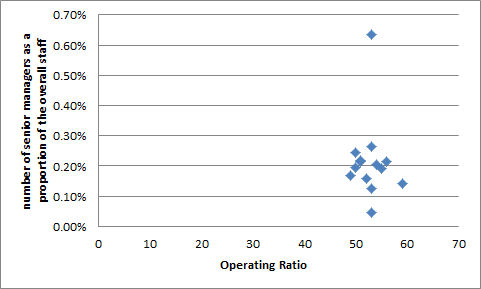
While information on the railway companies’ financial performance is easy to find for the entire 1870- 1914 period, employment data is a bit more elusive. The only year from which accurate data is available can be found is 1884, when the companies submitted a return of how many individuals they employed in all grades to the government. Thus, for this blog post I will look at the link between the number of managers companies’ had and their profitability in 1884 in Britain’s 14 largest railway companies. The central measure of company efficiency is the Operating (OR), which measures the company’s expenditure as a proportion of revenue. Thus, while imperfect, it does give some indication as to corporate performance. This will then be measured against the number of senior managers and administrators the companies’ had as a proportion of their total workforce, and also against the number of managers and administrators they employed per route mile operated.

Firstly, I looked at the OR against the number of senior managers as a proportion of the overall number of staff. This is shown below:-

As can be seen, there is no discernable correlation between how many senior managers the company employed to administer the staff and company performance. The one return that is out of place was the Taff Vale Railway, in which 0.63% of all employees were managers, a fact probably reflecting its smaller size.

I have then expanded the sample to include all the companies’ ‘administrators.’ By this I meant all the individuals that had a chance to go into management, such as clerks, station masters and inspectors. Thus, the next graph shows the OR against the number of administrative staff as a proportion of the companies’ total workforce:-

Once again, there is seemingly no strong correlation between the size of the management class proportional to the companies’ total workforces and the performance of them.

However, on discovering these results it didn’t conclusively prove that in 1884 the number of managers affected company performance. So, I wanted to take this further and decided to look at the number of managers per route mile open against the OR. The graph below shows this.

Again this reenforces the fact that the number of managers within companies did not affect their ORs in any real sense. The one ‘high’ figure was the Midland railway which seemingly had a very large number of senior managers per route mile operated (69.40). Contrastingly, the Taff Vale Railway, which had the same operating ratio of 53%, had the lowest number of managers per route mile operated (4.57).

Lastly, I looked at the number of administrators per route mile open against the OR. This is shown in the last graph below.

This is probably the graph that has the highest level of correlation between two data sets that I have chosen, showing, very weakly, that as the number of administrators per route mile open increased, so did the operating ratio. However, given what has been discovered above, I cannot conclusively say that incereased administrators per route mile increased the operating ratio.

Overall, what my very quick piece of research has shown is that in the very largest companies in Britain in 1884 the size of an organisations’ established executive and management class had almost no affect on their profitability. Companies with larger managements proportional to the staff or per route mile did not seem to gain from this fact, whereas those with smaller ones did not suffer devistating efficiency losses. Therefore, this suggests that by 1884 railway companies appointed managers based on the needs of operation and not based on an internal logic that dictated that increased management meant increased profit. It further suggests that in 1884 that British railway companies were not ‘top heavy’ in that they had too many managers.

Conversely, it has been well documented that 19th century Britishrailway companies’ were over-centralised, a factor that meant the numbers of senior managers in the industry was small proportional to the total workforce. Thus, what this evidence cannot show is whether significantly increased numbers of managere may have had an affect on companies’ performance in the long run as I have essentially measured the companies against their piers. Indeed, the fact that British railway companies managed themselves in very similar ways means that these figures may be of more use if compared with railways in other countries. Naturally, as with all things I post, this area of work needs more research...

Selasa, 01 Februari 2011

Canadian Mortgage Rule Changes

We have now been a couple of weeks into the new mortgage rule changes and the calm, reality is setting in. The Canadian real estate and Mortgage market is not going to fall off a cliff!! The changes the Canadian government made only affect a very small percentage of home buyers and even fewer clients that are refinancing. The banks have done a very good action by keeping conventional mortgages at 35 year amortizations and we even have a lender that offers 40 years. The bottom line is we still have historic low interest rates from low 2% range for variable.There is a lot of less selection which is firming up the prices once again. People are now buying for the reason they need and taking advantage of the great opportunities out there.