Firstly, the term ‘station master’ was not a universal one in the period, although it was certainly around. A London and South Western Railway rule book from 1845 called them ‘station clerks’, and in many cases this is what they were, simply clerks in charge of a station.[1] Indeed, the Great Northern Railway omitted the word ‘station’ altogether, calling officials in these positions ‘clerks-in-charge’ in 1856.[2] Nevertheless, it seems that other railways used ‘clerks-in-charge’ interchangeably with ‘station master’, as shown in the East Lancashire Railway’s 1856 rule book.[3] The most common alternative to ‘station master’ in the period was ‘station agent’, and the London and South Western Railway, after disposing of ‘station clerk’, retained this title right until the 1900 for all except those individuals administering large stations.[4] It was only in the 1860s that ‘station master’ became far more common and part of common parlance.
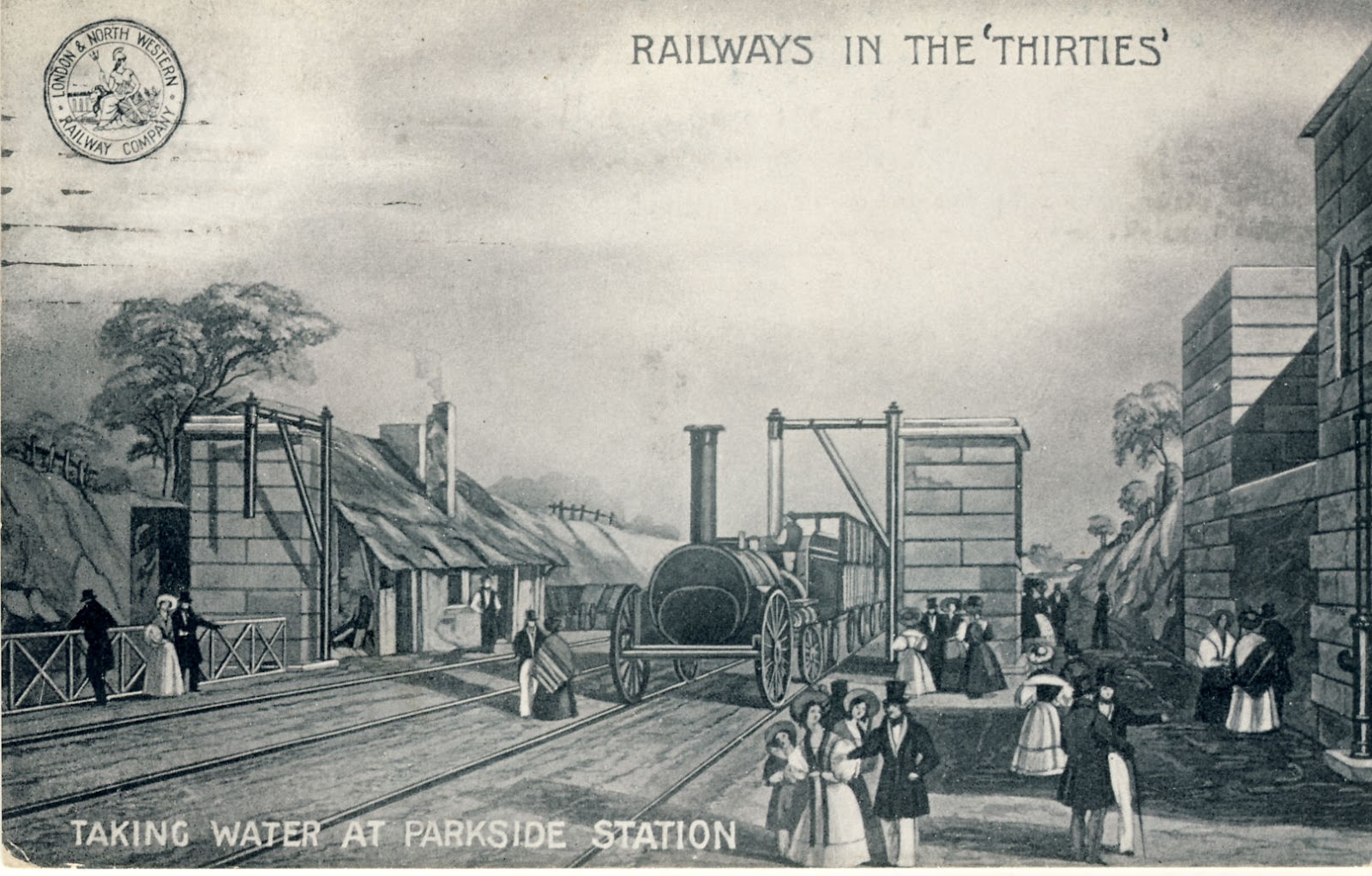
However, it is unsurprising that with men from many backgrounds filling these posts, not all were well behaved. In 1858 George Reeves, Station Master at Lowdham Station on the Midland Railway, pleaded guilty to embezzling the company out of an unspecified amount. In passing sentence the judge stated that he Reeves had been placed in a position of ‘great confidence and trust,’ and while he showed remorse, he was sentenced to six months hard labour.[6] In 1861 the cash held at the London and South Western Railway’s Windsor Station was found to be deficient. While no officials were found to be at fault, it is odd the management would then ‘break up the staff’ throughout the line [7] and remove the Station Master, John Madigan, to Petersfield with a reduction of salary.[8] Lastly, in 1865 at the Usk Quarter Sessions, Alfred Brown, station master at Hengoed Station on the Rhymney Railway, was charged with indecently assaulting Mary Ann Griffiths in a railway carriage.[9]
Of course, the majority of station masters in the period were honourable and did their job satisfactorily. Indeed, most had to have favourable references to be appointed. The Great Northern Railway’s ‘General Instructions and Regulations for the executive department’ stated that ‘experienced clerks’, who I presume were frequently appointed as ‘clerks-in-charge’, were required to have references from their ‘last employer’ and ‘one from each of two housekeepers of an undoubted respectability.’[10]

Furthermore, after around the mid-1850s it was highly unlikely that an individual would be appointed directly as a station master, as railway companies increasingly preferred these posts to be filled by individuals who had risen through the ranks. Thus, by this time potentially poor station masters were usually weeded out before they reached that post. For example, William Mears was appointed directly as ‘agent’ on the opening of Winchfield Station on the London and South Western Railway in May 1840.[11] Yet his son, Francis, had a longer road into that position. He was appointed as an apprentice clerk at Dorchester 1851, finally becoming ‘agent’ at Dinton fifteen years later in 1866.[12]
Additionally, as the years passed the rules regulating station masters’ work grew in number and were increasingly formalised. The London and South Western Railway’s 1853 rule book dedicated only thirteen pages to instructing station masters,[13] and the East Lancashire Railway provided only eleven in 1856.[14] However, as the complexity of the railway network and density of train movements increased, the regulations for station masters mirrored this by becoming more detailed. For example, in 1858[15] and 1865[16] the London and South Western Railway produced abstracts of ‘instructions which have from time to time been issued to the Station agents’, which were forty-two and 102 pages long respectively. This was in addition to the nineteen dense pages of instructions in the company’s general rule book of 1864.[17] Therefore, because of companies’ tightening regulation of station master's activities, there was less scope for them to misbehave or commit crime. Indeed, from a brief survey of on-line nineteenth century newspapers, the cases where this was so seemingly decline after the 1850s.
Therefore, the story of the early Victorian station master is one of a mixed bag of individuals doing a job which was not the same at every location or within every company. However, it is also one where what station masters did quickly became standardised and routine within the promotional and organisational frameworks the railway companies established.
-----
[1] London School of Economics Collection [LSE], HE1 (42) – 439, London and South Western Railway Rules to be observed by Enginemen and Firemen , 1845, p.iii-iv
[2] Author’s Collection, Great Northern Railway, General Instructions and Regulations for the executive department’, p.94
[3] LSE, HC1 (42) -41, Bye-laws, rules and regulations to be observed by the officers and men in the service of the East Lancashire Railway Company, Bury, October, 1854. p.51
[4] The National Archives, RAIL 1135/276,Rules and Regulations General Instructions and Appendices to Working Timetables: General Instructions to Staff, Station Staff, 1908
[5] The National Archives, RAIL 410/1805, Register of waged and salaried staff including station masters, agents, porters, policemen, pointsmen, signalmen, female cleaners, foremen, gatemen, shunters, clerks, breaksmen and lampmen.
[6] Nottinghamshire Guardian, Thursday, January 07, 1858, p. 3
[7] The National Archives [TNA], RAIL 411/217, Special Committee Minute Book, 11 January 1861
[8] TNA, RAIL 411/492, Clerical staff character book No. 2, p.416
[9] The Leeds Mercury, Saturday, January 7, 1865,
[10] Author’s Collection, Great Northern Railway, General Instructions and Regulations for the executive department’, p.94
[11] TNA, RAIL 411/491, Clerical staff character book No. 1, p.340
[12] TNA, RAIL 411/491, Clerical staff character book No. 1, p.305
[13] LSE, HE 3020 – L.84, Rules and Regulations for the guidance of the officers and servants of the London and South Western Railway, 1853, p.16-29m
[14] LSE, HC1 (42) -41, Bye-laws, rules and regulations to be observed by the officers and men in the service of the East Lancashire Railway Company, Bury, October, 1854. p.51-61
[15] TNA, RAIL 1035/269, Abstract of instructions which have from time to time been issued to the Station agents &c Previous to 1st May 1858
[16] TNA, RAIL 1035/270, Abstract of instructions which have from time to time been issued to the Station agents &c Previous to 1st June 1865
[17] Author’s Collection, Rules and Regulations for the guidance of the officers and servants of the London and South Western Railway, 1 August 1864, p.22-43


